ctf · October 12, 2026 · 6 min read
Nobody Knows Who's Good Anymore
CTFs have changed a lot since I started playing. And I’m not just talking about harder challenges or better tools. I’m talking about AI agents and how they’ve changed the way people compete.
I started doing CTFs about three or four years ago, casually at first. I’ve been playing regularly for roughly two years now.
Back then, I could spend hours stuck on a challenge. I’d read writeups, try different approaches, fail, and eventually figure things out. That was part of the experience.
Today, an AI agent can do much of that work for you. Sometimes it can solve an entire challenge without you understanding what happened.
And in a competitive environment, that raises a question I’ve been thinking about lately: what does solving a challenge actually say about someone’s technical skills anymore?
Playing CTFs and competing in them
I make a distinction between working on CTF challenges and competing in a CTF event.
When I’m training, the goal is usually straightforward: I want to understand something. I might spend hours on a reverse engineering challenge, a web vulnerability, or a privilege escalation path. Sometimes I need a writeup to get past a point I don’t understand. That’s part of learning.
A competition adds another goal: winning. Some players participate to improve their skills. Others want to place first, win a prize, or help their team climb the scoreboard. Some are just there to see how the event works. None of those motivations is new.
Competitive CTFs have also had their share of questionable behavior for years. Flag sharing, attacks against the platform, or targeting the organizers are examples of things people discuss when talking about how far someone might go to win. I won’t get into all of that here. The point is that competition has always created incentives beyond learning.
Someone mapped the whole range as an iceberg, from playing for fun and learning at the surface down to the taboo, forbidden, and cursed tactics underneath. It is worth a look.
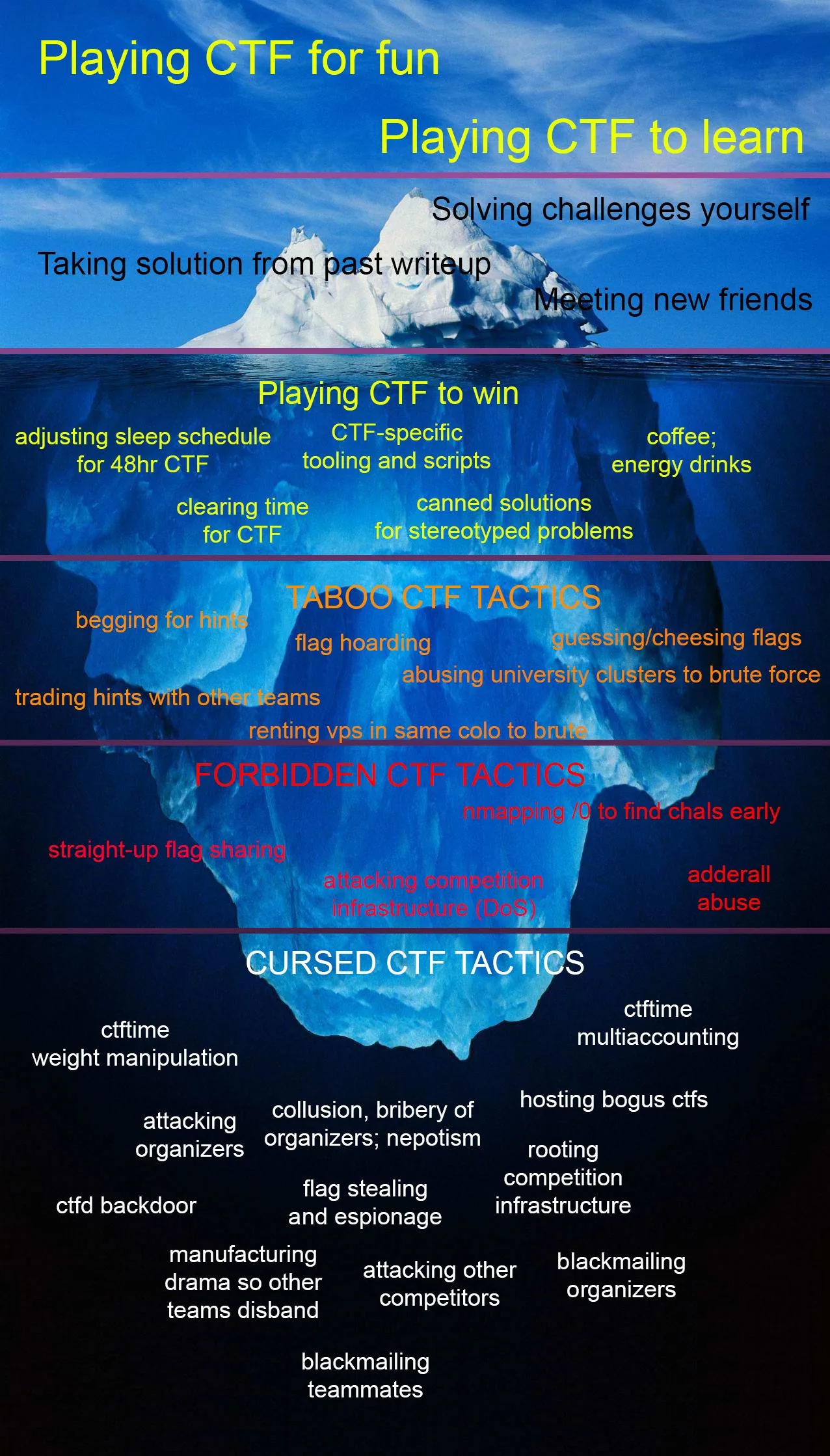
AI hasn’t created those incentives. It has changed what players can do with them.
Solving challenges with agents
Before agents became this capable, getting stuck often meant digging into the problem yourself. You would inspect a binary, trace an application, test an idea, fail, and try something else. You could stay on one challenge for hours. That was frustrating, but the moment you finally understood the bug or found the flag felt different because you’d followed the reasoning yourself.
Today, you can hand an agent a challenge and let it work through large parts of the process. Depending on the challenge and the tools available, it might inspect files, run commands, write scripts, test hypotheses, and come back with a flag. Some workflows go further and automate almost everything.
I do this too. Agents are genuinely useful to me, and pretending otherwise would be dishonest. They help me move faster and explore approaches I might not have considered. I don’t think using AI in a CTF automatically makes someone a bad player or means they aren’t learning.
But there’s a difference between using an agent to help you understand a challenge and handing it the entire challenge, waiting for a flag, and moving on.
If the only goal is to submit flags, the second approach works. If the goal is to develop technical skills, what have you actually taken away from that challenge?
What does a solved challenge prove?
This is the part that bothers me most.
On platforms like Hack The Box and TryHackMe, we see accounts with impressive stats: many solved challenges, high rankings, long streaks. Those numbers show activity and results. They don’t necessarily tell us how the challenges were solved or what the player understands.
That gap existed before AI, of course. People have always been able to follow writeups or get help from teammates. But agents make it much easier to repeat that process at scale. Someone with enough familiarity to operate the tools can potentially solve far more challenges than they could work through independently.
So what are we measuring? The ability to exploit a vulnerability? The ability to guide an agent? The quality of an automated setup? Those are not the same skill, even if they can all lead to the same flag.
I’m not saying that building a good agent workflow takes no skill. It does. And I don’t think every CTF needs to ban AI. I’m saying that a flag alone tells us less about a player’s individual technical understanding than we might assume.
There is also a personal side to this. I remember the satisfaction of finally solving something after hours of work. I still get excited when a challenge is solved, but letting an agent handle it from start to finish doesn’t give me quite the same feeling. I got the result, but I didn’t necessarily have the experience of getting there.
How organizers are responding
I’ve seen CTF challenges that include instructions apparently intended to interfere with AI agents. They try to redirect an agent’s behavior or stop it from continuing with a solution. In other words, prompt injection has started showing up as part of the contest environment.
That says something about the situation we’re in. Organizers are trying to adapt to players who can bring increasingly capable automated systems. Players can adapt their systems in return. I don’t see an obvious end to that cycle.
It also raises a difficult question for organizers: are they designing challenges to test a human’s understanding, a team’s ability to use every available tool, or some combination of both? Different events may reasonably choose different answers. But those expectations should be clear, especially when rankings and rewards are involved.
Why I still play
I’m not calling for people to stop using agents. I use them, and I plan to keep using them. They are part of how I work now.
I just think we should be clear about what we’re trying to get out of a CTF. If I want to learn reverse engineering, I need to understand the reverse engineering, not only collect the flag. If I want to compete for a prize, I might optimize for speed and results instead. Those are different goals, and AI makes the difference much more visible.
I don’t think we’ll go back to the way CTFs were a few years ago. The tools have changed, and so have the players. What really changed is that the usual signals stopped meaning much. We can no longer easily tell who understands a challenge from who simply handed it to an agent. The impostor syndrome has mostly disappeared: anyone can claim they’re able to solve a given challenge and then hand it straight off to their agent.
So none of this is an accusation. It’s an observation. Where it goes from here depends on what each player actually wants out of the game.